
Extensively studied
PrJINARC®: Demonstrated efficacy in patients from earlier to later stages of ADPKD
TEMPO 3:4
- Studied in 1,445 ADPKD patients
over 3 years - TKV and eGFR inclusion criteria
- Early, rapidly-progressing ADPKD (meeting modified Ravine criteria) in patients 18-50 years old
- TKV ≥750 mL
- Estimated creatinine clearance ≥60 mL/min
In earlier-stage ADPKD2,4†
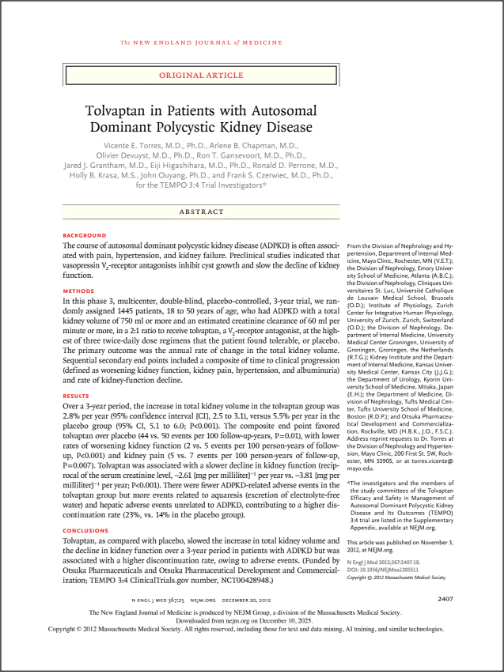
TEMPO 3:4 – In earlier-stage ADPKD2,4†

49% REDUCTION
in TKV growth rate vs. placebo over 3 years (2.8% vs. 5.5% with placebo, primary endpoint, p<0.0001)
Mean TKV at baseline: 1,692 mL; mean height-adjusted TKV: 972 mL
The effect of JINARC on TKV was greatest in the first year and included negative cyst growth (-1.7%) vs. positive cyst growth with placebo (4.6%), for a treatment effect of -6.3% (p<0.0001). During the second and third years, kidney enlargement progressed in both groups, although the rate of enlargement remained less in the JINARC group (absolute reductions relative to placebo: 1.92% per year [95% CI: 2.81 to 1.03%] at Year 2; 1.78% per year [95% CI: 2.77 to 0.78%] at Year 3). In addition:
- Tolvaptan has a short-term “secretory” effect on TKV, presumably due to its aquaretic effect, leading to diminution of renal cyst fluid.
- This effect appears largely reversible upon discontinuation of tolvaptan.
- This phenomenon will thus apparently overstate the effect of tolvaptan on renal cyst proliferation in the first year when measured by TKV.
26% REDUCTION
in rate of kidney function decline vs. placebo over 3 years, as measured by eGFR‡ (-2.7 vs. -3.6mL/min/1.73 m2/year; secondary endpoint, p<0.0001)†
Initiation of tolvaptan is associated with a generally reversible, prompt decline in GFR, likely due to hemodynamic factors.
REPRISE
- Studied in 1,370 ADPKD patients over 12 months
- eGFR inclusion criteria
- CKD from late stage 2 to early stage 4
- Patient age (<56): eGFR between 25 and 65 mL/min/1.73 m2
- Patient age (56-65): eGFR between 25 and 44 mL/min/1.73 m2, plus eGFR decline >2.0 mL/min/1.73 m2/year
In later-stage ADPKD2,5§
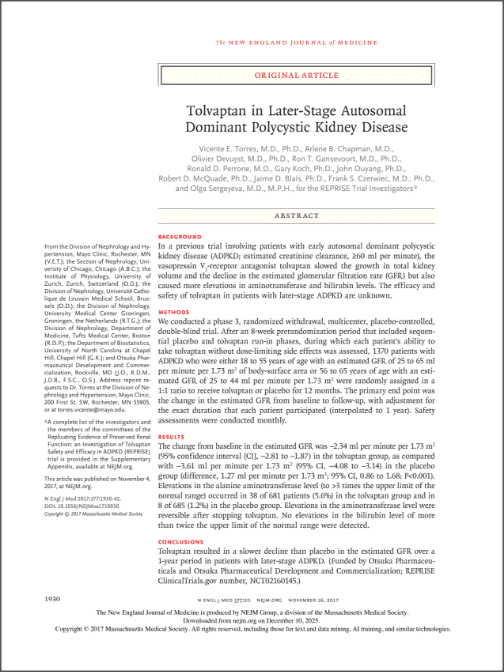
REPRISE – In later-stage ADPKD2,5§
35% REDUCTION
in the rate of decline of kidney function was observed in JINARC patients over 12 months (-2.34 vs. -3.61 with placebo, treatment effect of 1.27 mL/min/1.73 m2/year, primary endpoint, p<0.0001)
† TEMPO 3:4: A 36-month, double-blind, placebo-controlled, multi-center trial in patients with early, rapidly-progressing ADPKD (meeting Ravine criteria, TKV ≥750 mL, estimated creatinine clearance ≥60 mL/min). Patients were randomised at a 2:1 ratio to receive JINARC (n=961) or placebo plus SOC (n=484). Patients were titrated to receive the highest tolerable dose starting with morning and afternoon doses of 45 mg and 15 mg, respectively, with weekly increases to 60 mg and 30 mg, and then to 90 mg and 30 mg. All patients remained on standard concomitant medications.
‡ eGFRCKD-EPI
§ REPRISE: A 12-month, double-blind, placebo-controlled, multi-center trial in patients with chronic kidney disease (CKD) from late stage 2 to early stage 4 (eGFR between 25 and 65 mL/min/1.73 m2 if younger than age 56; or eGFR between 25 and 44 mL/min/1.73 m2, plus eGFR decline >2.0 mL/min/1.73 m2/year if between age 56-65). Patients were randomised at a 1:1 ratio to receive JINARC (n=683) or placebo (n=687). Patients were maintained on their highest tolerated dose for a period of 12 months but could interrupt, decrease and/or increase as clinical circumstances warranted within the range of titrated doses. All patients remained on standard concomitant medications.